

Comment choisir un masque d'anesthésie : guide pratique sur la taille, le coussinet et le matériau


Auteur
Découvrez la différence Xiamen Tianzuo Medical – où chaque produit témoigne de notre engagement envers la santé et la sécurité.
Marie R. Winters


Résumé : Le masque d’anesthésie est l’interface qui transforme l’administration de gaz en une voie aérienne étanche et contrôlable. Or, un masque mal dimensionné ou trop rigide entraîne des fuites d’agent anesthésique, une pression sur le visage et un ralentissement de l’induction. Ce guide accompagne les acheteurs de matériel d’anesthésie, les infirmières de bloc opératoire et les distributeurs dans leurs choix, en les aidant à identifier les facteurs clés de performance : adapter la taille du masque au patient (du nouveau-né à l’adulte), opter pour des coussinets en PVC à usage unique ou en silicone réutilisables, comprendre l’intérêt du connecteur de 22 mm et du dôme transparent, et évaluer le contrôle qualité et la documentation du fabricant lors des appels d’offres.
Pourquoi le masque d'anesthésie reste important
Même avec les dispositifs supraglottiques et les laryngoscopes vidéo, le masque facial reste la première et la dernière interface dans la gestion des voies aériennes : préoxygénation avant l’induction, ventilation entre les tentatives d’intubation et oxygénation en salle de réveil. Un masque étanche à basse pression de contact préserve la FiO₂ cible et la concentration en gaz anesthésiques volatils, limite le gaspillage de gaz anesthésique au bloc opératoire et réduit les marques de pression sur le visage lors des interventions longues. Pour les équipes d’approvisionnement, cela signifie que le masque le moins cher du devis est rarement le plus économique sur une année d’inductions ratées et de gaspillage d’agent anesthésique.
Trouver la bonne taille
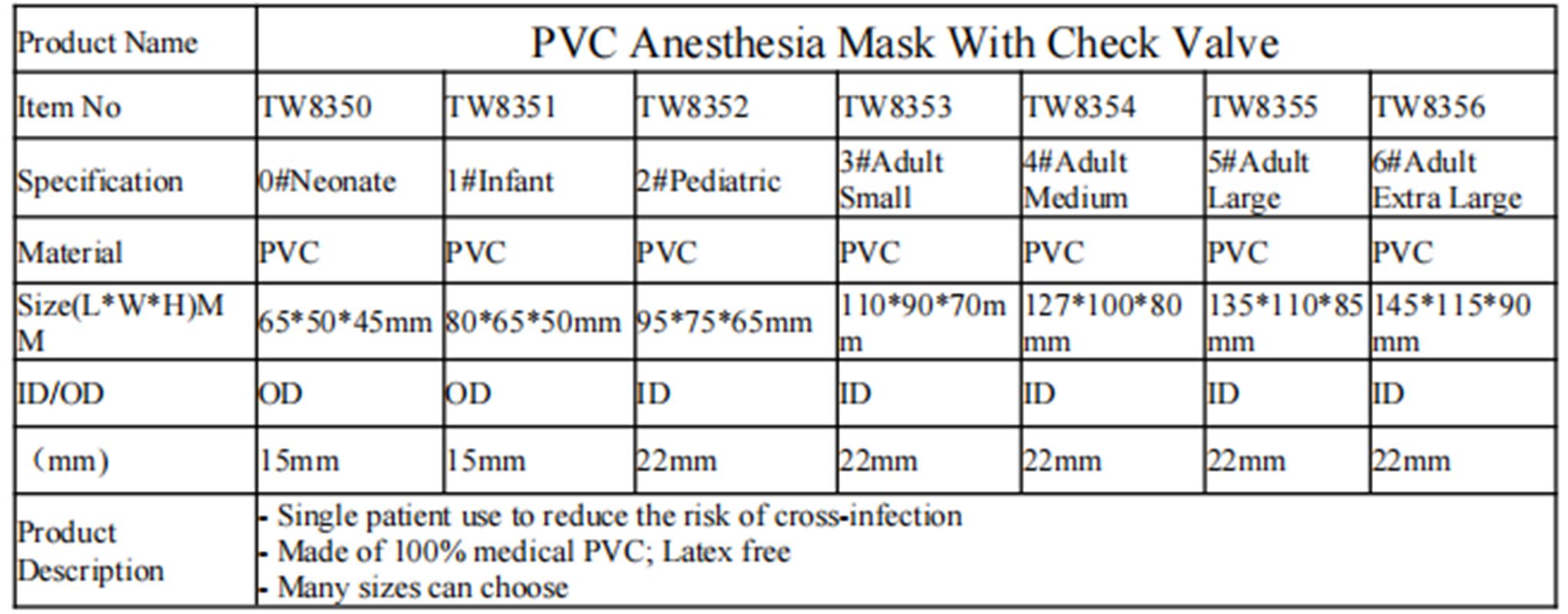
Choisir la bonne taille est la meilleure façon d'éviter les fuites. Les masques existent en différentes tailles, de la taille nouveau-né (0/1) à la taille adulte (5-6, voire 8 parfois), en passant par les tailles pédiatriques (2-4). Une méthode pratique au chevet du patient : aligner le masque de l'arête du nez jusqu'au menton sans comprimer les tissus mous, et positionner le coussinet sur des repères osseux, en évitant les yeux et les lèvres. Un masque trop petit ne permet pas une bonne étanchéité ; un masque trop grand crée un espace mort important et réduit la visibilité de la bouche. Prévoyez les tailles nécessaires à votre activité : un bloc opératoire général dispose des tailles 3 à 5, ainsi que d'un jeu pédiatrique ; une unité de néonatologie se limite aux tailles 0 et 1. Des anneaux de fixation de couleur facilitent la sélection en situation d'urgence.
PVC à usage unique vs silicone réutilisable
- PVC (à usage unique) : Économique, 100 % sans latex et à usage unique, ce masque élimine tout risque d'infection croisée. Son coussin d'air souple et pré-gonflé (comme sur notre modèle TW8374) épouse les contours du visage, permettant une étanchéité optimale avec une pression réduite. Emballé individuellement et traçable par lot, il est idéal pour les blocs opératoires à forte activité et les services d'urgence.
- Silicone (réutilisable) : Souple, autoclavable et conçu pour résister à des centaines de cycles. Son coût unitaire plus élevé est rapidement amorti dans les établissements disposant d'un processus de retraitement validé et d'une activité soutenue. Idéal pour la formation sur mannequins et les blocs opératoires où le retraitement est effectué entre chaque patient.
Une règle utile : « un patient, un masque » favorise le PVC ; « un masque, plusieurs cycles » favorise le silicone.
Coussin, connecteur et visibilité
- Coussin d'air : Un rebord gonflable permet d'ajuster précisément la pression d'étanchéité et convient aux personnes portant la barbe ou ayant des dents. Un gonflage excessif n'améliore pas l'étanchéité ; il ne fait qu'accentuer les marques de pression.
- Connecteur 22 mm : Le port standard se fixe directement sur les appareils d'anesthésie, les ventilateurs et les masques à valve unidirectionnelle sans adaptateur, et c'est précisément là que les déconnexions se produisent généralement.
- Dôme transparent : On peut voir la buée, les sécrétions et la couleur des lèvres sans soulever le masque – utile dès que l'induction s'intensifie.
- Anneau de crochet à code couleur : Permet de sélectionner rapidement la taille en situation de stress et sert également de point d'ancrage pour la sangle de tête.
Ce que les distributeurs doivent vérifier avant de s'approvisionner
Si vous évaluez des fournisseurs pour un appel d'offres ou une marque de distributeur, comparez-les selon les critères suivants :
- Certification de biocompatibilité et d'absence de latex (le PVC doit répondre aux normes de biocompatibilité).
- Emballage stérile unitaire avec indication de la taille, du lot et de la date de péremption imprimée sur chaque unité.
- Une gamme complète de tailles (du nouveau-né à l'adulte grand) dans un seul programme, vous permettant ainsi de proposer des emballages panachés.
- Documentation : Certifications CE, ISO 13485:2016 et inscription auprès de la FDA pour les marchés d'exportation.
- Rebond constant du coussin et moulage net — demandez des échantillons provenant de deux lots de production.
Produits associés
Pourquoi s'associer à Tianzuo Medical ?
Xiamen Tianzuo Medical Co., Ltd. conçoit et fabrique des produits d'urgence, d'anesthésie et de soins respiratoires sous un même toit : R&D, moulage et production intégrés, avec une expertise reconnue en OEM et ODM. Certifiés ISO 13485:2016, nos produits sont marqués CE et homologués FDA. Notre équipe a également participé à la rédaction des *Lignes directrices chinoises pour l'examen technique de l'enregistrement des insufflateurs manuels*, une expertise technique qui se retrouve dans chacun de nos masques. Pour les distributeurs et grossistes, nous proposons des solutions de marque privée, des quantités minimales de commande flexibles et des kits de documentation d'exportation (notice d'utilisation, étiquetage, traçabilité) conformes aux appels d'offres en Europe, au Moyen-Orient et en Asie. Si vous développez ou modernisez une gamme de consommables d'anesthésie, Contactez nos experts Pour obtenir des échantillons et des tarifs, ou envoyez un courriel directement à Stephen@tzmed.com.
Foire aux questions
Quelle taille de masque d'anesthésie me faut-il pour un adulte ?
Les masques d'anesthésie en PVC sont-ils sans latex ?
Les masques d'anesthésie sont-ils réutilisables ?
Quel connecteur convient à un appareil d'anesthésie ?
Tianzuo Medical propose-t-il des masques d'anesthésie OEM ?
- Comment utiliser un spiromètre à trois billes : Guide pratique pour la récupération respiratoire post-opératoire
- Comment choisir un dispositif d'immobilisation de la tête : Guide d'achat B2B pour les services d'urgence et les hôpitaux
- Canule nasale à haut débit (HFNC) : comment ça marche et quand la choisir plutôt qu’un masque à oxygène standard
- Canule nasale à oxygène : l’outil discret et indispensable de l’oxygénothérapie (et comment bien la paramétrer)
- Attelle pneumatique ou plâtre : quel dispositif d'immobilisation choisir ?
- Masque Venturi ou masque sans réinspiration : quel dispositif d’administration d’oxygène choisir ?
- Masque laryngé (LMA) ou sonde endotrachéale : comment choisir la voie aérienne appropriée
- Comment choisir un masque CPAP : masque facial complet, masque nasal ou masque à coussinets nasaux (Guide d’achat 2026)