

Attelles pneumatiques : un dispositif simple, mais seulement si vous l’utilisez correctement.


Auteur
Découvrez la différence Xiamen Tianzuo Medical – où chaque produit témoigne de notre engagement envers la santé et la sécurité.
Marie R. Winters


Commençons par une scène réelle.
Vous êtes sur place. Un patient présente une suspicion de fracture de l'avant-bras. Il souffre. Il faut le déplacer.
Vous sortez une attelle pneumatique. Vous l'enroulez autour de la jambe. Vous la gonflez.
Ça a l'air bien. Ça inspire confiance.
Mais cinq minutes plus tard, vous vérifiez à nouveau. L'attelle est plus souple. L'immobilisation est moins serrée. Que s'est-il passé ?
Ce n'est pas un cas isolé. Et ce n'est pas toujours une erreur de l'utilisateur. Parfois, c'est l'attelle elle-même qui est en cause.
Qu'est-ce qu'une attelle pneumatique, au juste ?
Un attelle pneumatique est essentiellement un pochette en plastique ou en vinyle à double paroiOn l'enroule autour du membre blessé, on la gonfle avec une pompe ou avec la bouche (oui, certains modèles le permettent), et elle durcit juste assez pour stabiliser la fracture.
Pas de charnières. Pas de boucles compliquées. Juste la pression de l'air.
Cette simplicité est sa force. Mais c'est aussi là que les choses se compliquent.
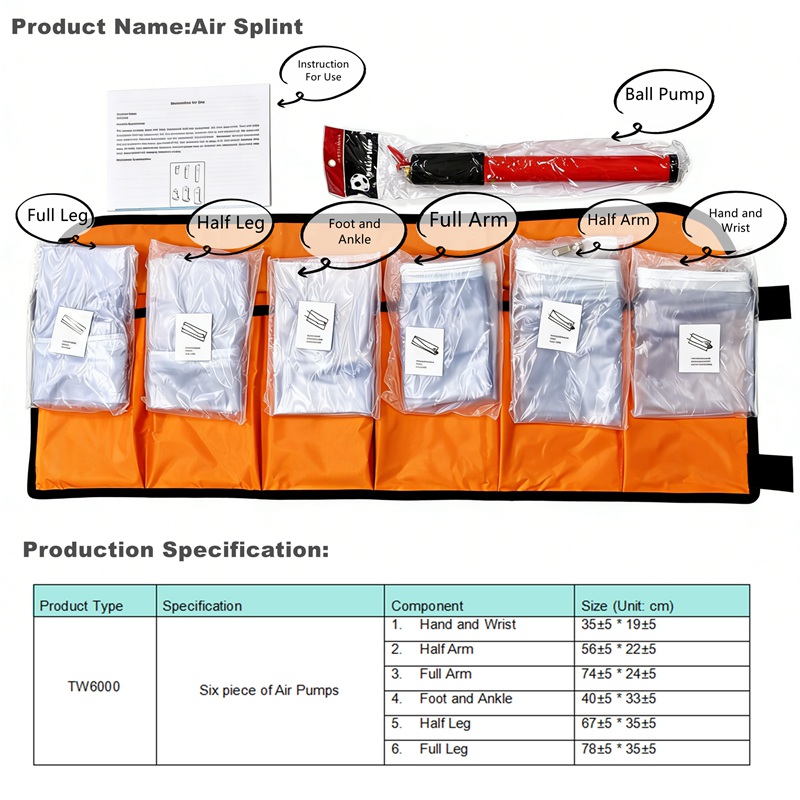
Les deux problèmes les plus courants que nous avons constatés
Nous fabriquons des attelles pneumatiques. Nous recevons également des appels de distributeurs qui nous demandent : « Pourquoi mes clients se plaignent-ils ? »
Dans 90 % des cas, il s'agit de l'un de ces deux-là.
1. Fuites lentes
Certaines attelles perdent de la pression après 10 à 15 minutes. Non pas à cause d'une mauvaise utilisation, mais parce que la soudure n'est pas suffisamment résistante.
On ne s'en aperçoit pas au premier gonflage. Mais au bout de quelques minutes ? Le membre se remet à bouger. Ça n'a plus aucun sens.
Les bonnes attelles maintiennent la pression pendant au moins 30 minutes sans nécessiter de réajustement. Les mauvaises ? Vous devrez les regonfler toutes les quelques minutes.
2. La fermeture éclair ou le velcro cède.
L'attelle en elle-même est peut-être correcte. Mais la fermeture est défectueuse.
Le velcro se bouche avec la saleté et ne colle plus. Les fermetures éclair se bloquent ou se cassent à mi-chemin.
Vous vous retrouvez alors avec une attelle parfaitement gonflée qui ne tient pas en place. Frustrant, n'est-ce pas ?
C'est pourquoi nous utilisons des fermetures éclair robustes et des bandes Velcro surdimensionnées. Ça peut paraître anodin, mais sur le terrain, ça fait toute la différence.
Où sont réellement utilisées les attelles pneumatiques ?
Pas seulement les ambulances. Voici où on les voit le plus souvent :
| Paramètre | Utilisation typique |
|---|---|
| Services médicaux d'urgence (SMU) | Stabilisation de la fracture avant le transport |
| médecine du sport | Blessures en marge du jeu — cheville, poignet, avant-bras |
| Cliniques et soins d'urgence | Immobilisation temporaire en préparation du plâtre |
| Hôpitaux militaires et de campagne | Solution légère et compacte pour les environnements distants |
| kits de soins à domicile | Pour les familles ayant des membres âgés présentant un risque de chute |
Donc même si vous ne vendez pas aux grands hôpitaux, il y a toujours un marché.
Critères de choix lors de l'achat d'attelles pneumatiques
Si vous vous procurez ces produits pour la revente ou un usage clinique, oubliez le marketing tape-à-l'œil. Vérifiez plutôt ceci.
✅ Résistance des coutures
Il s'agit du principal point faible caché. Des joints fragiles entraînent des fuites lentes.
Demandez à votre fournisseur : Quel est votre procédé de soudage ? S’il ne peut pas vous répondre clairement, soyez prudent.
✅ Qualité des vannes
La valve sert à injecter l'air. Les valves bon marché fuient. Ou alors, elles sont difficiles à manipuler avec des gants.
Testez-le. Gonflez-le. Laissez reposer 20 minutes. Vérifiez à nouveau.
✅ Options de taille
Les ensembles standard comprennent généralement :
Attelle de bras (pour l'avant-bras et le poignet)
Attelle de jambe (pour le bas de la jambe et la cheville)
Attelle cheville/pied (plus petite)
Si un fournisseur ne propose qu'une seule taille, demandez-lui pourquoi.
✅ Translucide aux rayons X ? Pas toujours
Certains acheteurs demandent des attelles radiotransparentes (pour éviter de les retirer lors des radiographies). Mais ce n'est pas une exigence pour tous les marchés.
Connaissez d'abord vos clients. Ne payez pas pour des fonctionnalités que personne n'a demandées.
Un mot rapide sur la réutilisabilité
La plupart des attelles pneumatiques sont réutilisables, à condition d'être correctement nettoyées.
Mais voici ce que les distributeurs ne précisent pas toujours : du sang ou des liquides biologiques peuvent s’infiltrer dans la pompe ou la valve. Par conséquent, à moins que leur conception ne permette un nettoyage complet, certains établissements les considèrent comme étant à usage unique.
Si vous commercialisez vos produits dans des environnements à haut risque d'infection (urgences, soins intensifs, ambulances), envisagez de proposer des versions jetables ou faciles à nettoyer.
Notre avis (sans blabla)
Les attelles pneumatiques ne sont pas de haute technologie. Elles n'ont pas besoin de l'être.
Mais elles doivent être étanches à l'air et rester fermées. Tout le reste est secondaire.
Nous les fabriquons depuis suffisamment longtemps pour savoir où les économies sont faites au détriment de la qualité. Nous, nous ne faisons pas ces économies-là.
Si cela vous importe — que vous soyez acheteur pour un hôpital, distributeur ou formateur en services d'urgence médicale — parlons-en.
Vous souhaitez des spécifications ou un échantillon ?
Nous pouvons vous envoyer :
Catalogue de produits avec tailles et matériaux
Rapport d'essai sur la résistance des coutures et la rétention d'air
Un exemple d'unité (si vous êtes sérieux)
Contactez-nous directement. Pas de faux formulaires ni de promesses en l'air.
- Comment utiliser un spiromètre à trois billes : Guide pratique pour la récupération respiratoire post-opératoire
- Comment choisir un dispositif d'immobilisation de la tête : Guide d'achat B2B pour les services d'urgence et les hôpitaux
- Canule nasale à haut débit (HFNC) : comment ça marche et quand la choisir plutôt qu’un masque à oxygène standard
- Canule nasale à oxygène : l’outil discret et indispensable de l’oxygénothérapie (et comment bien la paramétrer)
- Attelle pneumatique ou plâtre : quel dispositif d'immobilisation choisir ?
- Masque Venturi ou masque sans réinspiration : quel dispositif d’administration d’oxygène choisir ?
- Masque laryngé (LMA) ou sonde endotrachéale : comment choisir la voie aérienne appropriée
- Comment choisir un masque CPAP : masque facial complet, masque nasal ou masque à coussinets nasaux (Guide d’achat 2026)